PROF-CESANDO

  • Home
  • Introducción
  • _Introducción
  • _Neurociencia,educación y didáctica
  • Atención
  • _ Concepto
  • _Características
  • _Tipos
  • _Elementos claves
  • _Artículos
  • _Producto
  • _Material didáctico
  • _Material audiovisual
  • _Estrategias de enseñanza y aprendizaje
  • _Historias
  • Memoria
  • _Concepto
  • _Tipos
  • _Fases
  • _Artículos
  • _Producto
  • _Material didáctico
  • _Material audiovisual
  • _Estrategias de enseñanza y aprendizaje
  • _Historias
  • Motivación
  • _Concepto
  • _Artículos
  • _Producto
  • _Material didáctico
  • _Material audiovisual
  • _Estrategias de enseñanza y aprendizaje
  • _La ciencia de la motivación
  • _Historias

American Psychological Association. (Octubre de 2019). American Psychological Association. https://www.apa.org/ed/schools/teaching-learning/top-twenty/early-childhood/motivation 


The Learning Network. (2023, enero 19). What students are saying about what motivates them to learn. The New York times. https://www.nytimes.com/2023/01/19/learning/what-students-are-saying-about-what-motivates-them-to-learn.html


Simpson, E. H., & Balsam, P. D. (2015). The behavioral neuroscience of motivation: An overview of concepts, measures, and translational applications. En Behavioral Neuroscience of Motivation (Vol. 27, pp. 1–12). Springer International Publishing.

  • 0 Comments


                                                                     Motivación

La motivación abarca los factores internos y externos que influyen en las acciones del individuo, impulsandola a metas específicas. Si el individuo esta motivado, su energía y sus esfuerzos están orientados hacia la consecución de objetivos concretos. Esta fuerza impulsadora puede surgir de deseos personales, recompensas externas, o incluso de la inspiración que proviene de otros.


                                                                                 Referencias:


Motivación intrínseca y extrínseca: qué son y por qué las necesitas. (2023, 15 diciembre). Santander Open Academy. https://www.santanderopenacademy.com/es/blog/motivacion-intrinseca-y-extrinseca.html

VINTON, I. B. K. (2013). WHAT IS MOTIVATION?.

MSEd, K. C. (2023, 3 mayo). Motivation: the driving force behind our actions. Verywell Mind. https://www.verywellmind.com/what-is-motivation-2795378#toc-what-are-the-3-components-of-motivation

Candidate, B. S. M. P. (2024, 20 febrero). The Vital Importance and Benefits of Motivation. PositivePsychology.com. https://positivepsychology.com/benefits-motivation/#important

Howley-Rouse, A. (2023, 11 octubre). The role of motivation in learning. THE EDUCATION HUB. https://theeducationhub.org.nz/motivation/


  • 0 Comments


Elaboración Propia.


  • 0 Comments


Recuperada de:https:Yellow llustrative Creativity Tips Infographic - Infografía (canva.com)


  • 0 Comments


Sacado de: https://acortar.link/hNJhgY

Videos


Infographics

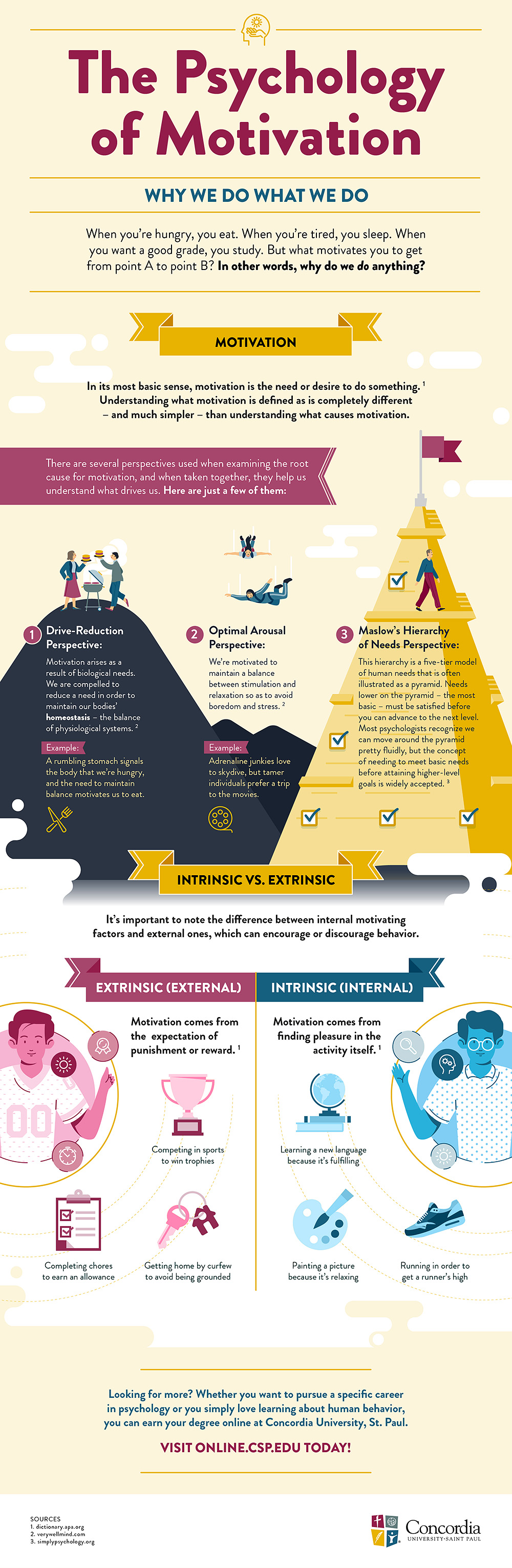
The psychology of motivation. (2020, julio 9). CSP Global. https://online.csp.edu/resources/infographic/psychology-of-motivation/


References
  • (S/f-c). Recuperado el 27 de mayo de 2024, de http://://www.studocu.com/en-us/document/grand-canyon-university/early-adolescent-and-adolescent-psychology/motivate-kids-infographic-adams/10979666
  • Koca, Fatih. “Motivation to Learn and Teacher-StudentRelationship.” Journal of International Education andLeadership, vol. 6, no. 2, 2016,files.eric.ed.gov/fulltext/EJ1135209.pdf#:~:text=teacher%E2%80%93student%20relationships%20on%20children%E2%80%99s%20motivation%20to%20learn%20and.Accessed 10 Dec. 2020.
  • Saliskar, Holli Van. “Using Badges in the Classroom toMotivate Learning.” Faculty Focus |Higher Ed Teaching &Learning, 16 May 2014,www.facultyfocus.com/articles/teaching-with-technology-articles/using-badges-classroom-motivate-learning/.
  • Scott, Ken. “Using the E-Portfolio to Validate StudentLearning.” Faculty Focus | Higher Ed Teaching &Learning, 12 Feb. 2013,www.facultyfocus.com/articles/teaching-with-technology-articles/using-the-e-portfolio-to-validate-student-learning/.
  • Wilcox, L. (2018, June 12). Top 5 Strategies for MotivatingStudents - NBPTS | Shaping the profession that shapesAmerica’s future. Retrieved from NBPTS | Shaping theprofession that shapes America’s future. website:https://www.nbpts.org/top-5-strategies-for-motivating-students/


  • 0 Comments

Cómo motivar a los niños: enfoques basados ​​en la ciencia para padres, cuidadores y profesores 

¿Cuál es la mejor manera de motivar a los niños? 
  • La motivación intrínseca para aprender sobre el mundo que nos rodea, comienza en la infancia. La motivación intrínseca se refiere a realizar una actividad por sí misma. Estar intrínsecamente motivado significa sentirse competente y autónomo.


Bibliografía

American Psychological Association. (Octubre de 2019). American Psychological Association. https://www.apa.org/ed/schools/teaching-learning/top-twenty/early-childhood/motivation

Center of the developing child. Harvard University . (s.f.). https://developingchild.harvard.edu/resources/how-to-motivate-children-science-based-approaches-for-parents-caregivers-and-teachers/


  • 0 Comments


Elaboración propia

Bibliografía 

Center of the developing child. Harvard University. (s.f.). https://harvardcenter.wpenginepowered.com/wp-content/uploads/2021/01/inbrief-motivation-Final.pdf

  • 0 Comments

Estrategias de motivación en el aula 


3 Estrategias de Motivación en el Aula de Clase

Estrategias de Motivación en el Aula de Clase


Estrategias de Motivación en el Aula de Clase


Estrategias de Motivación en el Aula de Clase


  • 0 Comments
Inicio

Prof-cesando

Prof-cesando

Investigative group

Investigative group

Where we are now

Where we are now

About us

Eimy Lorena Cuenca Parra, Gabriela Palacios Moreno, Isabella Neva Patiño e Isabel Páez Rojas

recent posts

Labels

Atención Introducción Memoria Motivación

instagram

Template Created By : ThemeXpose . All Rights Reserved.

Back to top